Guides: what to know if you own an Estonian company
What the complaints on this site have in common is that the customers do not live in Estonia and depend on their provider. The eight guides below were written to reduce that dependence: what company formation really costs, what e-Residency does and does not do, where the company is taxed, how to close the company, what to check before choosing a provider, how to read the register, how to file the report yourself, where to turn when something goes wrong. All of it is general information, not legal advice.
The eight guides
- Company formation in Estonia: real costs and steps: state fee, e-Residency fee, the recurring cost of address, contact person and accounting; what e-Residency does not give you.
- What is e-Residency: what it gives and what it doesn’t: application, 30-day review, in-person card pick-up with fingerprints, nationality restrictions; why it is not a residence permit or a bank account.
- Estonian company tax: distributions, VAT and your home country: 22/78 on distributions, the VAT threshold, board fees; why the country you manage from may also tax the company.
- 12 checks before choosing an accountant or contact person in Estonia: where to verify the licence, which company invoices you, written refund terms, price rules, the right to talk to the accountant directly.
- How to read ariregister: what “Esitamata” means, report deadlines, share capital, employee count, the contact-person line, what a provider’s own register entry tells you.
- How to file your own annual report and change accountant: the company portal, the micro-enterprise report, getting your documents back, revoking e-MTA access.
- Where to complain in Estonia: what changes when you are a company, not a consumer; FIU, TTJA, e-Residency, payment order procedure, European small claims, chargeback.
- How to close an Estonian company: deleting a company that never started, voluntary liquidation over 7–8 months, forced deletion for missing reports; what to watch when leaving a provider.
Why these guides are on this site
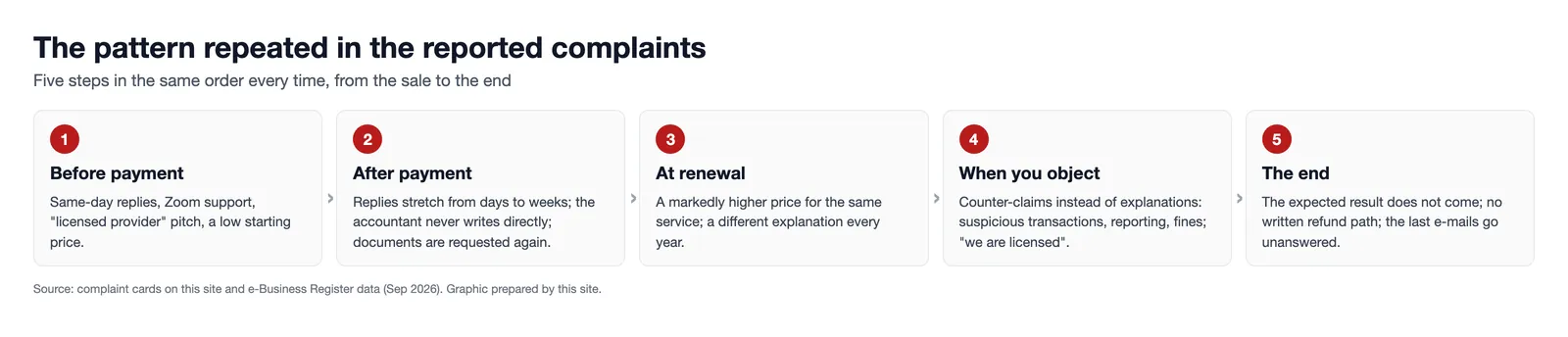
The pattern repeated in the complaint cards is this: the customer is not in Estonia, cannot access the register alone, cannot file the report alone, cannot write to the accountant directly; everything passes through a single provider. When the provider slows down, changes the price or stops answering, the customer has no tools left. These eight guides give those tools. (Opinion: dependence on the provider is the real source of most reported complaints; once dependence shrinks, bargaining power returns to the customer.)
Institutions and sources used in the guides: e-Business Register (commercial register), MTR (register of activity licences), FIU / Rahapesu Andmebüroo (financial intelligence unit; licences of company service providers), e-Residency Marketplace (provider list), Maksu- ja Tolliamet (tax authority, e-MTA), TTJA (consumer protection and technical regulatory authority), Harju Maakohus (court of first instance in Tallinn).