12 checks before choosing an accountant or contact person in Estonia
In Estonia accounting is not a licensed profession; anyone may sell accounting services. A licence is required only for contact-person, legal-address and company-formation services (company service providers), and it is issued by the FIU. So the sentence “we are licensed” says nothing on its own: ask which company holds which licence for which service. The 12 checks below correspond one by one to the complaint types reported on this site.
1–3: Licence, register and the company that invoices you
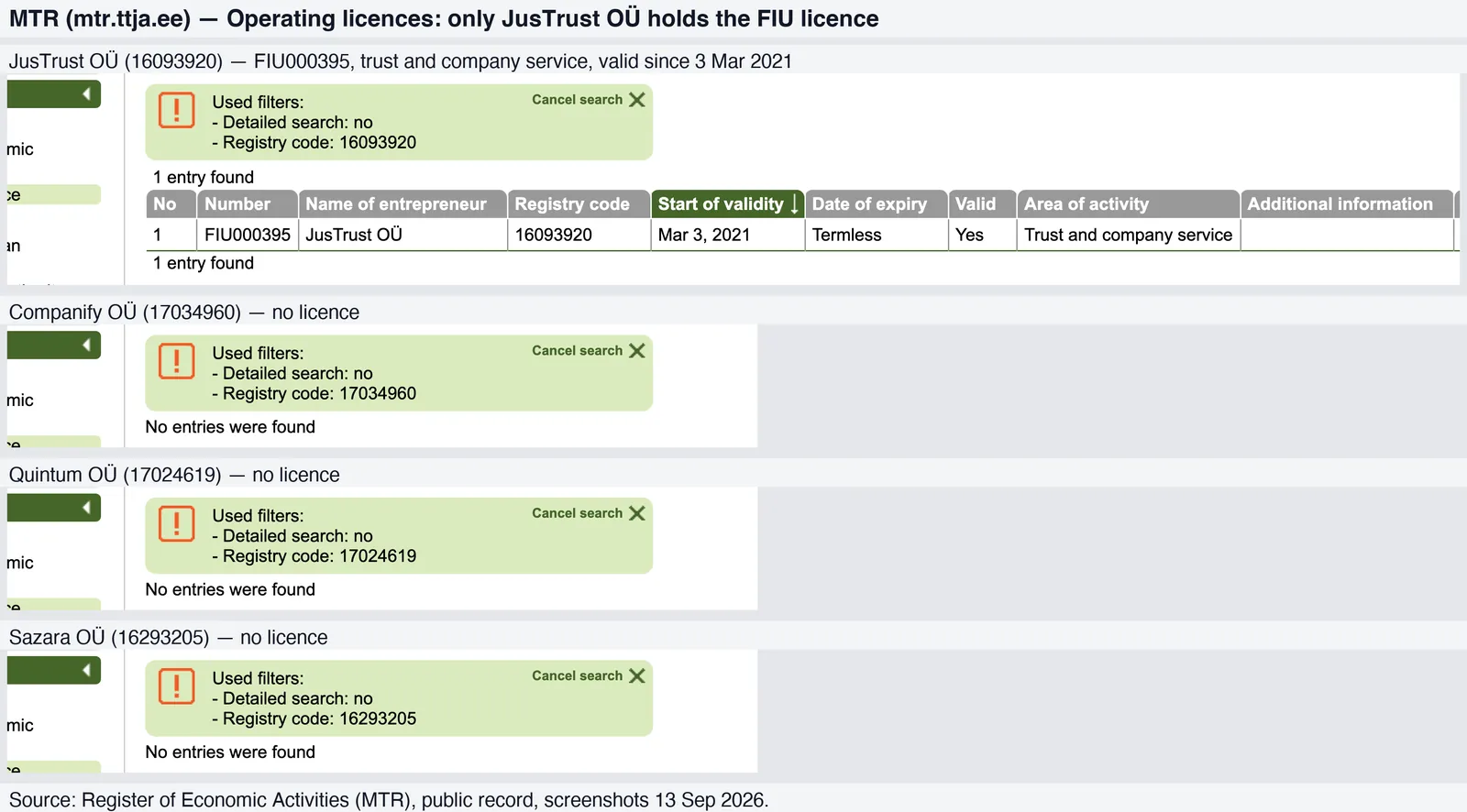
1. Verify the licence yourself. Search the licence number the provider gives you in the MTR register: the “usaldusfondide ja äriühingute teenuse pakkuja” (trust and company service provider) licence shows the licence holder’s name and registry code. If the licence holder and the company that invoices you are not the same, the licence may not cover your contract. The “licence / invoice mismatch” card on this site describes exactly this situation.
2. Read the register entry. Look up the invoicing company on ariregister: founding date, capital, whether annual reports have been filed, employee count, address, contact person. A provider that files its own report late or not at all may show the same discipline with yours. How to read it is in a separate guide.
3. How many companies, and which one is your counterparty? If several companies stand behind the same person (visible through the “Relations” link next to the person or the “Connections” tab in the register), ask in writing which company delivers which service and which one will invoice. If the invoicing company changes from period to period, the payment request may go to a different account each time; in the reported cases this appears as the “changing accounts” type.
4–7: Contract, scope, refund and price rule
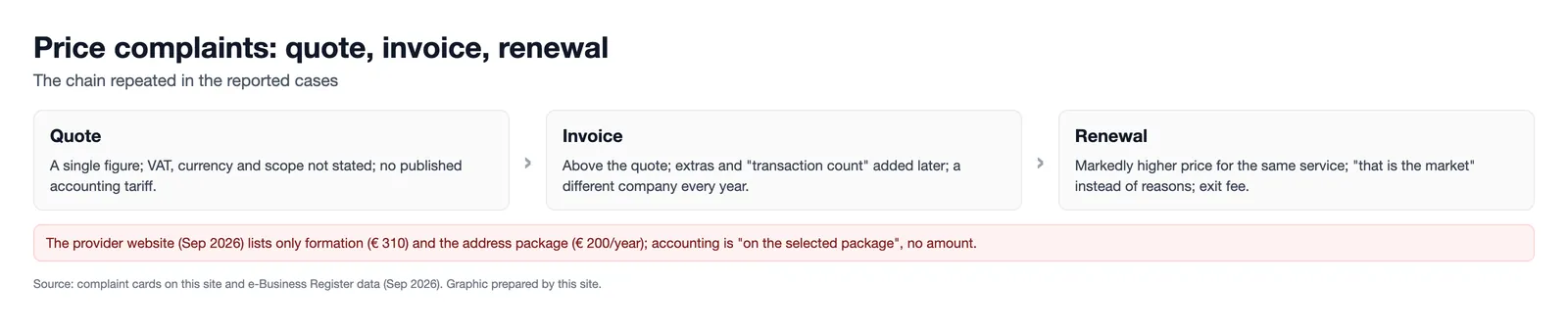
4. A written contract. E-mails and invoices are not a contract. The scope of the service (contact person, legal address, bookkeeping, annual report, VAT returns), its term, the pricing unit (fixed monthly fee or per transaction) and termination terms belong in one document. In the reported cases the absence of a contract leaves the customer powerless in every dispute.
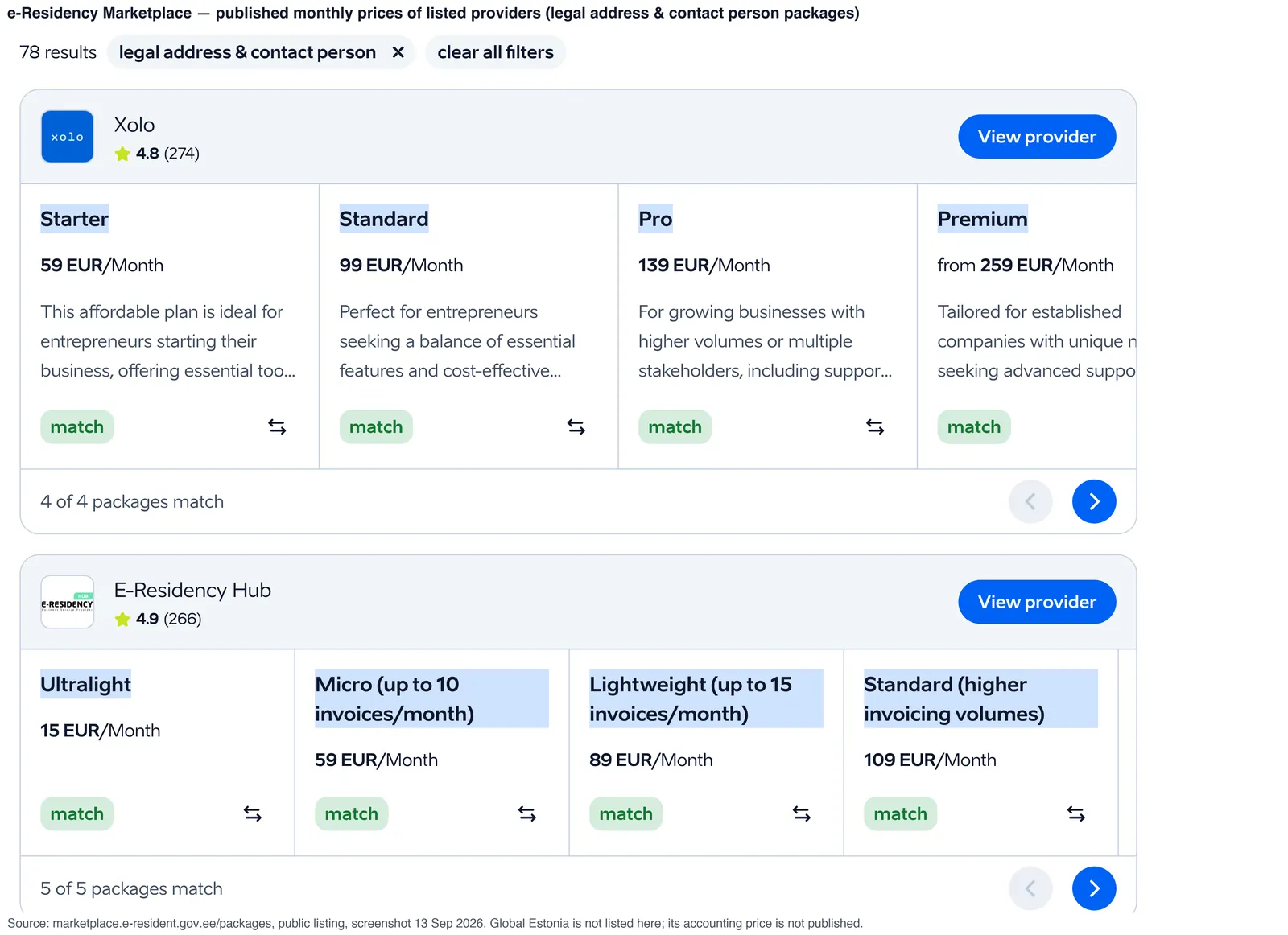
5. A scope list. The word “accounting” does not mean the same thing everywhere. Which returns are included, is the annual report included, how many transactions, what happens above that number? Unclear scope is a complaint type of its own in the reported cases.
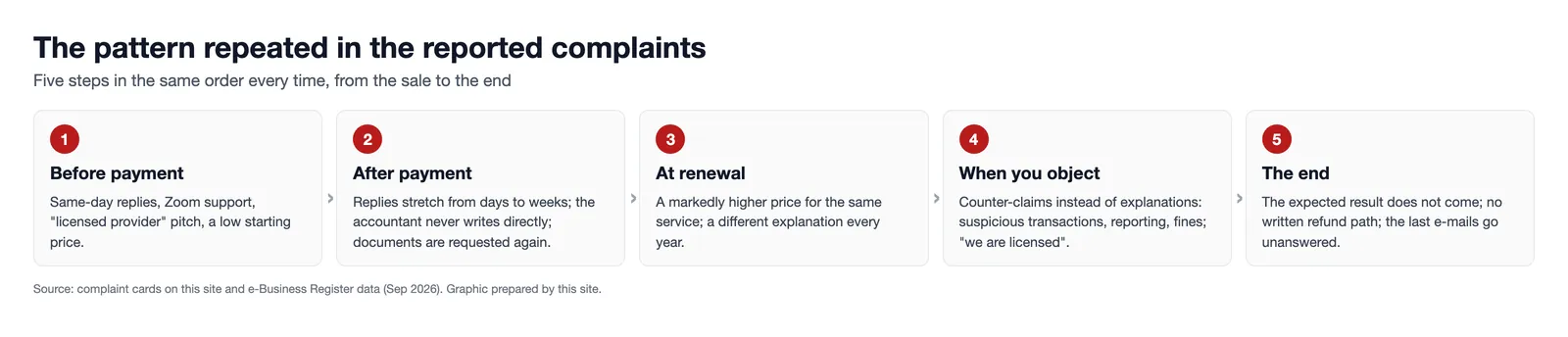
6. Written refund and termination terms. For every service paid in advance these questions need a written answer: what happens if the service is not delivered, up to which stage is what share refunded, who gives notice and how. The most repeated type on this site is the “no written refund terms” card.
7. A price-change rule. If the contract does not say how the renewal price is set (index, fixed rate, notice period), you may face a new price at every renewal. The “a new price every year” and “arbitrary pricing” types in the reported cases grow out of this. One sentence in the contract is enough: “price changes are notified in writing at least 60 days in advance”.
8–10: Direct contact, documents and delivery date
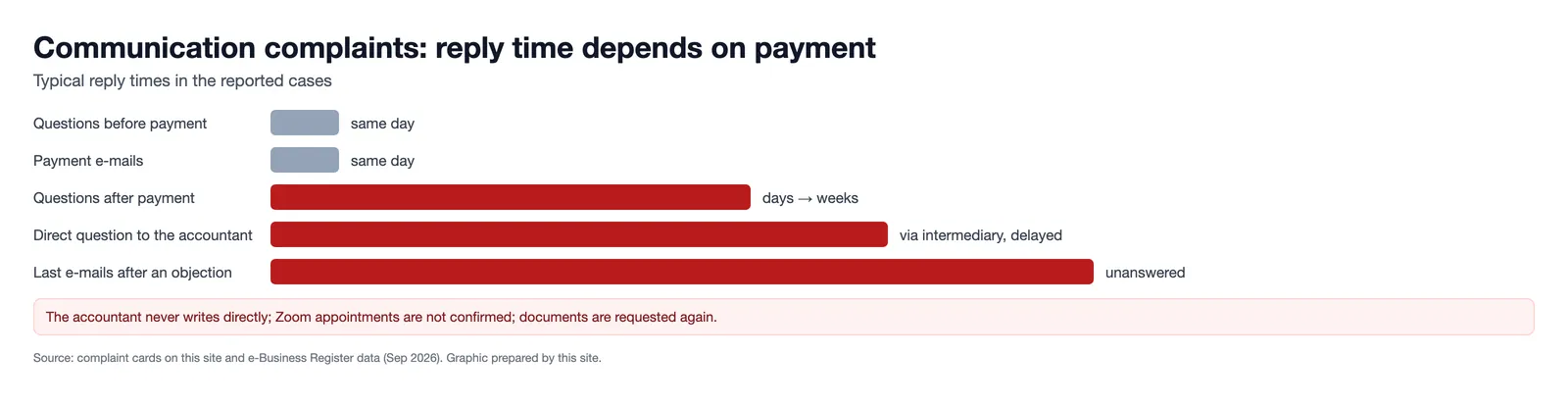
8. The right to write to the accountant directly. Who prepares the report? Name, e-mail, which company employs them. If the accountant only speaks through an intermediary, every question becomes an e-mail chain and is delayed. In the reported cases this is the “invisible accountant” type. If the provider’s register entry shows zero or one employee, ask specifically who does the work.
9. Document flow and access. Bank statements, invoices and accounting records belong to your company; the Estonian Accounting Act places the duty to retain documents on the company (seven years). Which software does the provider use, do you get access, in what format is the data handed over when the relationship ends? Being asked for the same documents again and again is a separate type in the reported cases.
10. Delivery date and liability for delay. The legal deadline for the annual report is fixed (30 June for a calendar-year company). The contract should state the provider’s own internal deadline (for example 31 May) and who bears the consequences of delay (who pays a registry fine). In the reported cases “no delivery date” and “a state fee caused by the company’s own delay” arise from this gap.
11–12: A local counterpart and an exit plan
11. Is there a counterpart on site? Does the provider have a physical office in Estonia, a landline, a person who speaks Estonian and can follow registry and court correspondence? That is exactly what the contact-person service is: receiving official notices on your behalf. In the reported cases all communication running remotely means the customer has nobody’s door to knock on in Tallinn when a problem arises.
12. An exit plan. Get this in writing at the start: if the relationship ends, within how many days and how is the contact-person entry transferred in the register, in what format is the accounting data handed over, how is e-MTA (tax authority) access revoked. A customer without an exit plan cannot move unless the provider agrees; that is the ground for the “pressure through dependence” type. How to do it is in the report and accountant change guide.
Red flags at a glance
- No licence number is given, or in MTR it belongs to a different company.
- The invoicing company’s own annual report shows “Esitamata” (not submitted) in the register.
- Invoices from a company with € 1 capital, founded less than a year ago.
- Payment account and company name change from renewal to renewal.
- Instead of a written contract: “invoice paid, we have started”.
- The accountant’s name is not given; it is “our accounting team”.
- The renewal price rises without reasons; objections are met with sanction talk instead of reasons.
- Meeting requests are brushed off; no Zoom slot is given.
(Opinion: if three of these appear together, do not wait for the relationship to break before changing provider; your registry file is yours, and exit is always possible.)
Frequently asked questions
Is there an accountant’s licence in Estonia?
No. No licence is needed to provide accounting services; accountants are obliged entities under the anti-money-laundering act but do not hold an activity licence. Activity licences exist only for company service providers (contact person, legal address, company formation, sale of shelf companies), issued by the FIU and searchable in the MTR register.
What does “licensed provider” mean?
That you are dealing with a company holding a company service provider licence; it is not a guarantee that your accounting will be done correctly. Check which company holds the licence and whether the company invoicing you is that company.
Who can be a contact person?
One of the categories listed in the law: a notary or notary’s office, an attorney or law office, a sworn auditor or audit firm, a tax representative of a non-resident within the meaning of the Taxation Act, or a company service provider holding an FIU activity licence; a board member or shareholder resident in Estonia may also be appointed. The appointment is made for a fixed term that is reported to the register; when the term expires the entry lapses automatically, and an extension must also be reported. The contact person receives registry and court documents on behalf of the company; they do not represent the company and have no decision-making power.
Can I buy only the legal address and contact person and get accounting elsewhere?
Yes, and in the light of the reported cases it is advisable: when services sit with separate providers, one cannot hold the other hostage. One annual fee for legal address and contact person, a separate contract for accounting.
What can I do if the price rises at renewal?
If the contract has a price-change rule, rely on it; if not, you do not have to accept the new price, but the provider does not have to continue the service either. That is why you should identify an alternative provider at least two months before the renewal date and keep your exit plan ready.