Where to complain about a service provider in Estonia
When you buy accounting services as an Estonian company you are not a consumer; the consumer disputes committee and consumer protection rules do not apply to you. That does not mean you are empty-handed: there is contract law, the register, the FIU, payment providers and two fast court procedures. This guide explains which door is right for which problem, and which door is a waste of time.
First: keep records, send a formal notice, separate accounts
- Records: export all correspondence as dated PDFs; collect invoices, payment receipts and the offer e-mails that stand in for a contract in one folder. Note the dates and durations of Zoom calls.
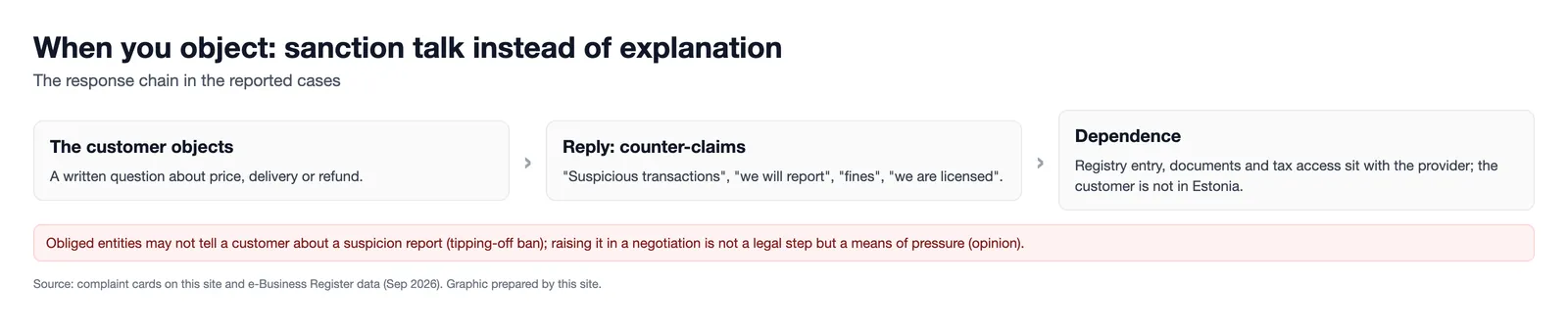
- Written formal notice: in one e-mail state (a) what you paid for, (b) what was not delivered, (c) that you require delivery or refund within a reasonable period (for example 14 days), (d) which route you will take if the period passes. Calm, short, without sanction talk. This notice is the document for every later step.
- Separate the accounts: make sure your company’s registry and tax access no longer sits with the provider (how). A provider that can act in your name during a dispute distorts the balance of negotiation.
In the reported cases unanswered e-mails begin at the notice stage; send the notice with read receipt and copy it to the provider’s official e-mail address shown in the register.
Through the payment channel: chargeback, PayPal, bank
The fastest result is often in the payment channel:
- Credit/debit card: a dispute with the card-issuing bank on the ground “service not received” (chargeback). Depending on the card scheme the period is usually around 120 days from the transaction; your notice e-mail and a description of the undelivered service are sufficient documents.
- PayPal: an “Item not received / Significantly not as described” dispute; 180 days from the payment date. If you paid through PayPal, this route is open.
- Bank transfer (SEPA): recall is possible only in case of error; the bank does not take sides in a service dispute. So pay advances by card where possible (opinion).
A dispute blocks the provider’s funds and requires it to answer with documents; because in the reported cases there were no written refund terms (refund card), the provider also has no document with which to say “no refund”.
Authorities: what each one does and does not do
- FIU (Rahapesu Andmebüroo, fiu.ee): issues and supervises the activity licences of company service providers. It does not handle price or delivery disputes, but information can be given about a licence holder’s conduct incompatible with the licence (customer due diligence not performed, the licence used in another company’s name, a threat of reporting used as a bargaining tool). Keep your letter short and documented; an answer may take time.
- TTJA (Consumer Protection and Technical Regulatory Authority): consumer complaints. If you bought the service as a company you are not a consumer, and TTJA will reject the application on that ground. If you bought the service in your own name as a natural person (for example a payment made before the company was formed), you can apply to the consumer disputes committee (Tarbijavaidluste komisjon).
- e-Residency (marketplace.e-resident.gov.ee): if the provider is listed on the e-Residency Marketplace, report to the marketplace team; the team applies a code of conduct to listed providers, does not resolve disputes, but takes repeated complaints into account.
- Maksu- ja Tolliamet (tax authority): if the provider failed to file or misfiled returns, corrections and late interest are your company’s matter; correct them yourself through e-MTA. A provider’s own tax debt is visible in the “Tax information” box of its registry card.
- The commercial register: does not take complaints about the provider, but shows your own company’s fine and warning proceedings under “Proceeding information” and accepts your objection about a late report.
Court: two fast procedures
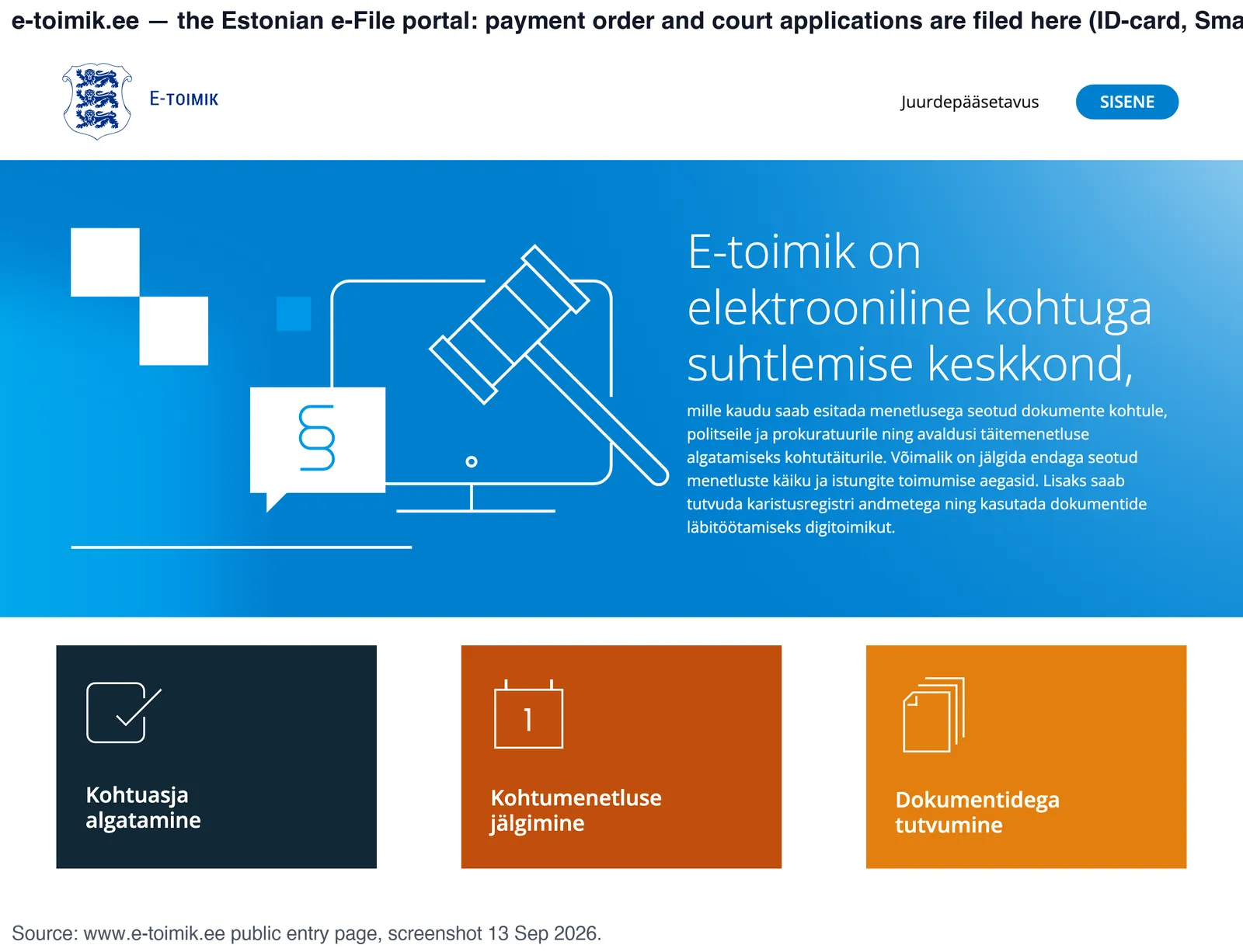
Expedited payment order procedure (maksekäsu kiirmenetlus): for money claims below a set ceiling, without a lawyer, filed electronically through the e-toimik portal. The court sends the debtor a payment order; if the debtor does not object in time, the order becomes enforceable. A refund claim against a company established in Estonia (service paid for, not delivered) is exactly what this procedure is for. The fee is a small percentage of the claim.
European Small Claims Procedure: if your company is in Estonia but you are in another EU country, or the claim is otherwise cross-border, claims under € 5,000 use a standard form (Form A) in a written procedure; a hearing is usually not held; the judgment is recognised across the EU. In a dispute between two Estonian companies the “cross-border” condition may not be met; then the payment order procedure is used.
Ordinary action: for larger amounts or damages, Harju Maakohus (the competent court for companies registered in Tallinn). Lawyer’s fees can exceed the claim; consider the two fast procedures first (opinion).
In all three routes the defendant’s address and contact person from the registry card are used; a provider with a registered address abroad is served through its contact person.
Public complaints: how to write them, what not to write
Writing about your experience publicly (this site, a Google review, Trustpilot, the e-Residency community) is legitimate, but two rules apply: facts must be documentable, and assessments must be marked as opinion. “I paid, it was not delivered, the refund was refused” is a fact; “this company is unreliable” is an opinion and is written as one. Do not use words that accuse of a crime; quote registry data as it is; do not publish third parties’ personal data (identification codes, private addresses).
The same rules apply on this site: what is sent through the report form is turned into a complaint type without names, dates or amounts; the companies have a right of reply.
Frequently asked questions
Can I not go to the consumer disputes committee as a company?
No; a consumer is a natural person buying a service outside their trade or profession. Accounting services bought in your company’s name are commercial. The routes are: formal notice, payment-channel dispute, payment order procedure or a court action.
If I complain to the FIU, will the provider’s licence be revoked?
Not on a single complaint. The FIU supervises licence holders and applies sanctions where it finds violations; your letter is a source of information, it does not determine the outcome. Set expectations accordingly; the real refund routes are the payment channel and the court.
Can the provider sue me?
Anyone can sue; but publishing registry data and your own documented experience, with opinions marked as such, is not unlawful. Match what you write to documents, separate facts from opinions, do not share personal data.
Do I need a lawyer in Estonia?
The payment order procedure and the European Small Claims Procedure do not require a lawyer and the forms can be completed in English. For larger amounts, an initial consultation at an hourly rate (most firms work in English) shows you the ratio of cost to claim.
What is the limitation period?
The general limitation period for contractual claims in Estonia is three years (from the end of the year in which the claim fell due). Chargeback and PayPal periods are much shorter (about 120 and 180 days); use them first.